

Resources to Guide Discussions About Consent, Sexual Harassment and Misconduct
Recent national data continue to show that sexual harassment remains widespread. For example, the #MeToo 2024 national survey (fielded by NORC) found that 78% of women reported experiencing verbal sexual harassment, one of the most common forms reported. At the same time, research on prevention points to a persistent gap in adult guidance: many young people say they have not received clear, practical conversations from parents or other trusted adults about boundaries, consent, and how to avoid harming others, which makes proactive, age-appropriate discussions an important part of prevention.
In order to promote safety, adults should guide appropriate conversations with adolescents and teens about preventing and reporting sexual harassment and assault. But many feel uncomfortable or don’t know how to begin the conversation. To help adults navigate these important discussions, OnlineMSWPrograms.com has compiled resources to guide them through the process.
Statistics About Sexual Misconduct and Reporting in the United States
Without seeing the numbers, it’s easy for parents—and their children—to assume a child might never encounter sexual misconduct in their life. In reality, it’s likely that a person will experience sexual misconduct before they reach adulthood. As pointed out in the Harvard report, insults with sexualized language, catcalling and inappropriate advances are common experiences for young women. However, sexual assault is also more common than many people think.
According to these statistics from the National Sexual Violence Resource Center (NSVRC):
45.1%
Nearly half of women in the U.S. have experienced some form of contact sexual violence in their lifetime.
16.9%
More than 1 in 6 men in the U.S. have experienced some form of contact sexual violence in their lifetime.
21%
More than 1 in 5 women have experienced completed or attempted rape in their lifetime.
3.2%
About 1 in 31 men (3.2%) have experienced completed or attempted rape in their lifetime.
51.1%
female rape victims reported being raped by an intimate partner.
52%
of male rape victims reported being raped by an acquaintance.
National data show that many sexual assaults are never reported to law enforcement, and underreporting is especially common among youth and college students.
About two-thirds of sexual assaults are not reported to law enforcement. RAINN estimates that roughly 310 out of every 1,000 sexual assaults are reported to police (about 31%), meaning about 69% are not reported, according to RAINN.
Child sexual abuse is widely underreported to authorities. RAINN notes that only about 10% of child sexual abuse is disclosed to legal authorities.
On college campuses, many incidents still go unreported to law enforcement. RAINN reports that 80% of female college students who experience sexual violence do not report to the police.
Understanding these statistics is especially important for adolescents and teens because what students learn about consent, healthy relationships, and sexual health varies widely by state and school district. According to the Guttmacher Institute, in many places, sex education requirements and content are limited or inconsistent, so trusted adults can play an important role in filling gaps with medically accurate, age-appropriate information.
Understanding Consent
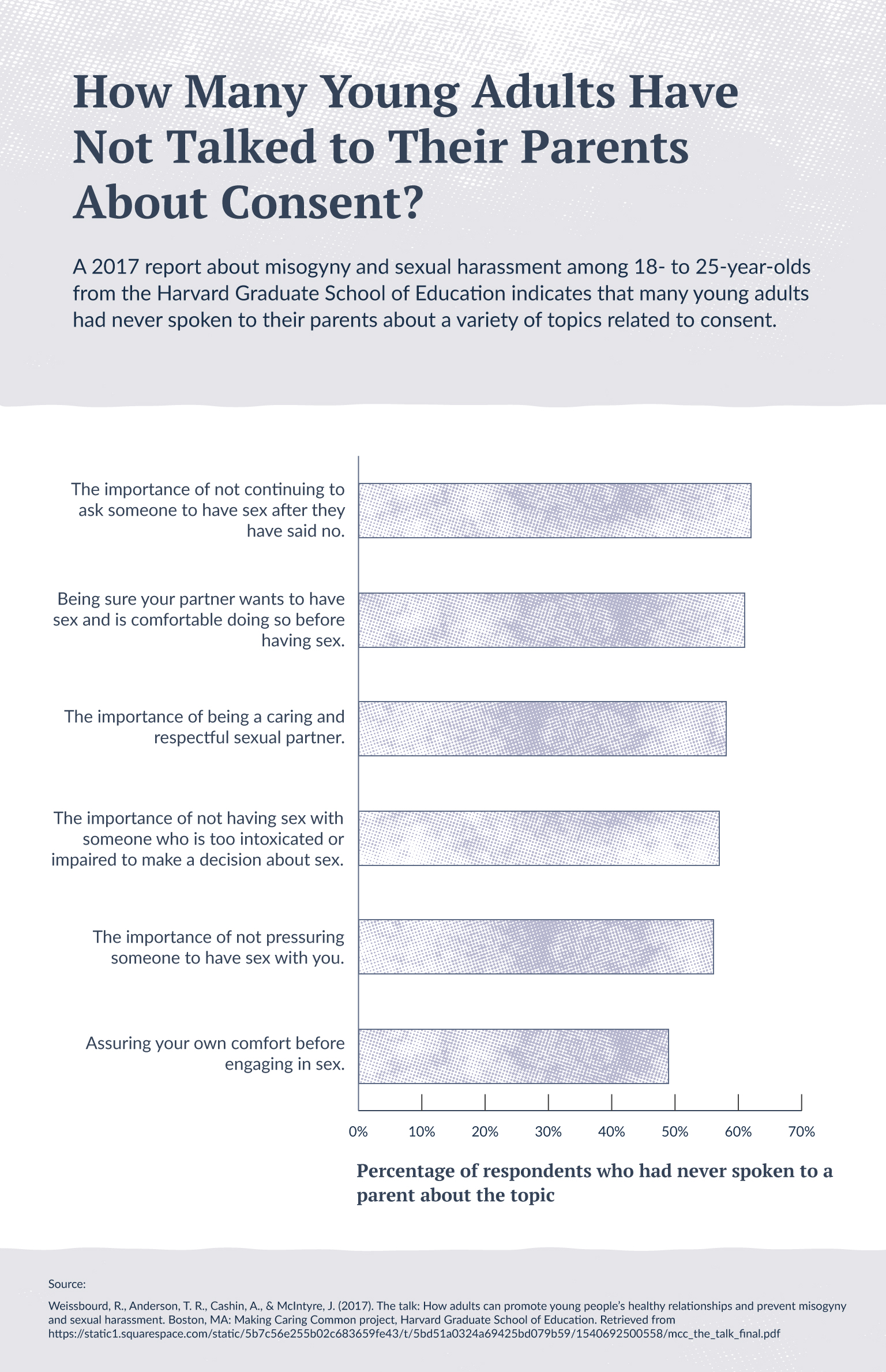
The findings from the Harvard report indicate that many adolescents and teens are not learning about consent from their parents. More than half of respondents had never spoken to a parent about pressuring others to have sex with them or having sex with someone too intoxicated or impaired to make a decision.
Defining Consent
According to RAINN, consent is a mutual agreement to engage in sexual activity, and it must be clear, voluntary, and communicated without pressure, manipulation, or fear.
A verbal “yes” can help clarify consent, but consent isn’t valid if it’s given under pressure, manipulation, intimidation, or fear. Even if someone says “yes” at first, they can change their mind at any time.
RAINN says that consent should be reestablished at multiple stages of intimacy instead of being interpreted as a blanket statement. The organization points out that it’s OK for a person to change their mind at any time.
People communicate interest and comfort in different ways, but consent must still be clear and mutually understood. Relying solely on body language or assumptions can lead to misinterpretation, so checking in and obtaining explicit, voluntary agreement is safer and more respectful.
Whether parents or teachers are broaching the topic, understanding consent can begin with education about learning to share with others and can be gradually introduced in more mature topics, like sex education.
Resources for Talking About Consent With Adolescents
- Consent for Kids — Blue Seat Studio: video for kids about what it means to be in control of one’s own body, belongings and choices.
- Teen Dating Violence Prevention Resources — NSVRC: updated roundup of prevention-focused materials for working with teens, including resources for parents/caregivers on talking about healthy relationships and consent, plus tools that address confidentiality/mandated reporting and supporting teen survivors.
- 5 Rules for Getting Consent — RAINN: practical, teen-friendly guidance that frames consent as clear, voluntary, and ongoing, with simple rules for checking in, respecting boundaries, and understanding that someone can change their mind at any time.
- ASK. LISTEN. RESPECT. — TeachConsent.org: free videos and discussion guides designed to help parents, educators, and teens build practical consent skills (asking clearly, listening to boundaries, and respecting “no”), with materials that support age-appropriate conversations about healthy relationships and sexual respect.
- How to Talk to Kids About Consent — Child Mind Institute: advice about conversations regarding consent and substance use, verbal and non-verbal consent, and the pressure to be sexually active.
Discussing Sexual Assault and Harassment
Talking about sexual assault and harassment can be stressful for adults if they’re worried about exposing children to graphic information or introducing mature subjects before they’re ready. But waiting until the end of adolescence to have these discussions may be too late to prevent incidents of sexual misconduct.
Defining Sexual Harassment
According to the U.S. Equal Employment Opportunity Commission (EEOC), sexual harassment can include unwelcome sexual advances, requests for sexual favors, and other verbal or physical harassment of a sexual nature.
RAINN notes that sexual harassment can happen in many settings, including the workplace, at school, online, in public spaces, or even at home, and that it can take many forms (verbal, physical, or technology-based) when the attention is unwanted.
Defining Sexual Assault
RAINN defines sexual assault as sexual contact or behavior that happens without consent. It can include attempted rape, unwanted sexual touching, forcing someone to perform sexual acts, nonconsensual penetration (rape), and coercing or manipulating someone into sexual activity through threats, intimidation, lies, guilt, or psychological pressure.
Coercion can involve threats, intimidation, persistent pressure, or emotional and psychological manipulation, none of which produces valid consent.
Both sexual harassment and sexual assault are unlawful and can result in detrimental outcomes for survivors of these activities. Adults should explain the seriousness and severity of these behaviors in age-appropriate discussions.
Explaining sexual assault and harassment can begin with defining the terms and providing examples of what healthy relationships should look like.
Resources for Talking About Sexual Assault and Harassment
- Essentials for Parenting Teens: Communication Resources — CDC: curated support and crisis resources for parents/caregivers, plus guidance that can help adults talk with teens about difficult topics and safety planning.
- love is respect — Healthy Relationships (for teens/young adults): teen-centered education on healthy vs. unhealthy relationship dynamics, boundaries, and getting help. This resource is helpful for framing conversations about coercion, pressure, and warning signs.
- Resource Library — Futures Without Violence: searchable library of materials on domestic/sexual violence, harassment, stalking, trafficking, and teen dating violence.
- 10 Ways to Teach Your Kid Skills About Preventing Sexual Abuse — Child Mind Institute: variety of strategies that parents can use to educate their children when they’re ready to talk about sexual abuse and harmful behaviors.
- Talking to Your Kids About Sexual Assault — RAINN: actionable ideas and talking points for parents and their children to discuss personal safety and looking out for others.
- Children’s Behaviors Toolkit — Stop It Now: overview of children’s behaviors that can be considered warning signs for instigating or experiencing harmful and abusive activity.
Identifying and Reporting Sexual Harassment and Assault
Even when sexual misconduct is widely discussed online and in the news, teens and young adults may still be unsure where to go for confidential support or how to report safely if they choose to. Clear, age-appropriate guidance from trusted adults can help young people understand their options.
The National Child Traumatic Stress Network (NCTSN) notes that teens may avoid reporting sexual assault for reasons such as not wanting family or others to know, feeling unable to prove what happened, fear that police won’t take it seriously, or fear of hostility from police.
Adults can build trust with teens and adolescents by listening to and validating their feelings and desires to report, and by making sure not to blame them for an experience where they felt victimized or unsafe.
Talking to teens about reporting misconduct can ensure that they have a meaningful, actionable understanding of what to do if their consent or bodily autonomy is violated and they’re in need of help.
Resources for and About Reporting Sexual Misconduct
- The National Sexual Assault Hotline (Online Chat) — RAINN: 24/7 online chat tool for users to speak with a trained professional about seeking help or reporting an assault. This chat is anonymous and not recorded.
- Crisis Text Line — free, 24/7, confidential text-based crisis support. In the U.S. (and Puerto Rico), text HOME to 741741; in the UK, text SHOUT to 85258 (Shout).
- Find Help Near You — RAINN: a tool for users to find the closest sexual assault help center to their home or current location and access information about what kinds of services are available at local centers.
- Find Help — NSVRC: list of organizations in each state dedicated to supporting rape crisis efforts.
- Your Rights — U.S. Equal Employment Commission: a list of federally recognized rights for youth who are employed in any state regarding their right to work free of discrimination or harassment.
- Sexual Harassment at Work: What Could Happen (If You Report)? — Equal Rights Advocates: guide to possible outcomes after reporting sexual assault or harassment that includes a link to a sample internal complaint document re: sexual assault for survivors of any sexual misconduct in need of guidance on writing an official complaint to an organization. This guide is available in English and Spanish.
- Avoiding Victim Blaming — Center for Relationship Abuse Awareness & Action: explains why victim-blaming is harmful and offers supportive, nonjudgmental language adults can use when someone discloses abuse or assault.
- What to Expect If You Report Assault or Abuse to Law Enforcement — RAINN: step-by-step overview of what typically happens if a survivor reports to police (initial report, investigation, evidence collection, and possible legal outcomes), written to help survivors and supporters make informed, safety-centered decisions about reporting.
If you or somebody you know has experienced sexual assault, you can call the National Sexual Assault Hotline at 800.656.HOPE (4673). RAINN’s hotline offers free, confidential, 24/7 support from trained support specialists who can help you find resources and explore options, including reporting. RAINN states that hotline calls are not recorded, and you don’t need to provide your name, location, or other identifying information to get help. If a caller chooses to share identifying information and is under 18 (or a vulnerable adult), RAINN notes that they may be legally required to report that information to local authorities.
Are you interested in supporting survivors of traumatic events? Learn more about how to become a licensed clinical social worker and read more about the opportunities that online clinical social work programs offer.
The following table contains tabular data from the graphic in this post.
How Many Young Adults Have Not Spoken to a Parent About Consent?
Recent research suggests that parent-teen conversations about sexual health (which can include consent, boundaries, and healthy relationships) are inconsistent—and that the quality of those conversations matters.
In a nationally representative study published in 2025 by JAMA, of 522 U.S. parent-teen (ages 15–17) dyads, researchers found that the frequency of parent-teen sexual health communication varies across families, and that frequent communication is most beneficial when parents feel informed and comfortable discussing these topics. When parents do not feel informed or comfortable, even frequent conversations can be associated with lower teen confidence in seeking sexual and reproductive health information and services.
Takeaway for adults: It’s not just “talk more”; it’s about talking clearly and calmly, using accurate information, checking for understanding, and reinforcing that teens can ask questions, set boundaries, and seek help without blame.
Information last updated: February 2026